Evaluating Wine Bottle Label Mockup No 3 for Professional Design Presentation
In the competitive landscape of beverage branding, the transition from a flat digital file to a tangible product representation is often where design concepts succeed or fail. Wine Bottle Label Mockup No 3 serves as a specialized bridge in this process, offering designers and marketers a high-fidelity environment to visualize label artwork before production begins. Unlike generic packaging templates, this specific asset focuses on the nuances of wine bottle aesthetics, providing a realistic canvas that accounts for lighting, texture, and dimensional curvature. For professionals aged 20 to 50 working in creative agencies, freelance design, or boutique winery marketing, understanding the practical utility of this mockup is essential for efficient workflow and effective client communication.
Technical Specifications and Visual Fidelity
The primary value proposition of any digital mockup lies in its resolution and rendering quality. Wine Bottle Label Mockup No 3 is engineered at 4928×3712 pixels with a density of 300 dpi. This specification is significant because it exceeds standard web display requirements, allowing the file to serve dual purposes. Designers can use the same asset for high-resolution print portfolios, large-format presentation boards, and crisp social media content without needing to source multiple versions. The pixel density ensures that fine typographic details, embossing effects, and paper textures remain sharp even when zoomed in during client review sessions.
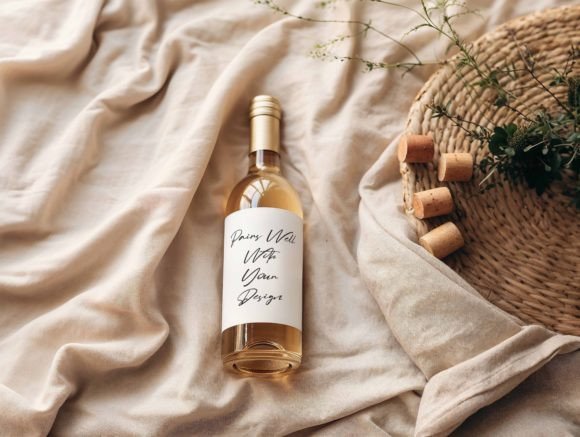
Beyond raw resolution, the visual fidelity addresses common pitfalls in wine label presentation. Wine bottles are inherently reflective and cylindrical, creating complex lighting scenarios that are difficult to replicate manually. This mockup captures authentic specular highlights and shadow gradients that interact naturally with the label area. When a designer applies a matte, gloss, or textured paper stock via smart objects, the underlying lighting map adjusts to maintain realism. This attention to optical accuracy prevents the "floating sticker" effect that often undermines amateur presentations, ensuring the artwork looks physically adhered to the glass rather than digitally superimposed.
Workflow Efficiency Through Smart Object Integration
For freelancers and agency teams operating under tight deadlines, usability is as critical as visual quality. Wine Bottle Label Mockup No 3 utilizes Photoshop’s smart object layer architecture to streamline the customization process. This non-destructive editing approach allows users to double-click a layer, paste their flat label design, and save to see an instant update on the 3D-rendered bottle. This eliminates the need for manual warping, perspective correction, or blending mode adjustments that typically consume hours of production time.
A notable functional advantage of this specific iteration is the customizable cap color. In wine branding, the foil capsule is rarely an afterthought; it is a core component of the color story and shelf presence. Many stock mockups lock this element into a fixed gold or black tone, forcing designers to either accept a mismatch or spend additional time masking and recoloring. By exposing the cap as an editable variable, Wine Bottle Label Mockup No 3 acknowledges the holistic nature of wine packaging. This flexibility allows for accurate prototyping of monochromatic luxury designs, vibrant rosé capsules, or traditional burgundy foils without breaking the photorealistic illusion.
Strategic Applications in Branding and Marketing
The practical application of this asset extends far beyond simple portfolio filler. In real-world scenarios, Wine Bottle Label Mockup No 3 functions as a decision-making tool across several business verticals.
- Client Approval Cycles: Stakeholders often lack the spatial imagination to visualize how a 2D PDF will translate to a curved surface. Presenting a photorealistic render reduces ambiguity and accelerates sign-off by managing expectations regarding scale and legibility.
- E-Commerce and Pre-Launch Marketing: Wineries frequently need to list products or launch crowdfunding campaigns before physical inventory arrives. High-quality renders provide professional sales assets that maintain brand integrity during the pre-production phase.
- Design Competitions and Awards: Submission guidelines for packaging awards often require contextual photography. This mockup provides studio-quality imagery without the expense of hiring a photographer, renting lighting equipment, or sourcing physical bottles.
- Social Media Content Creation: For marketers managing Instagram or Pinterest accounts, consistent visual language is key. Using the same high-quality mockup template ensures that all posted label variations share uniform lighting and perspective, reinforcing brand recognition.
Assessing Limitations and Best Practices
While Wine Bottle Label Mockup No 3 is a robust tool, objective evaluation requires acknowledging its boundaries. As a digital simulation, it cannot perfectly predict manufacturing outcomes. Factors such as specific paper absorption, ink spread on uncoated stocks, and varnish registration are physical variables that no digital file can fully replicate. Professionals should treat this mockup as a visualization aid rather than a proofing substitute. It is excellent for aesthetic evaluation but should always be followed by a physical press proof for final color matching.
Additionally, the specific bottle silhouette used in this mockup dictates its suitability. If a project involves a unique proprietary bottle shape—such as a squat Provence rosé bottle or an elongated Riesling flute—the standard Bordeaux-style profile of this mockup may not accurately represent the final product. Designers must verify that the mockup’s geometry aligns with their client’s actual packaging specifications. Using a mismatched bottle shape, even with perfect label placement, can mislead clients about proportion and shelf footprint.
To maximize effectiveness, users should also consider environmental context. While the isolated studio shot provided is versatile, integrating the rendered bottle into lifestyle photography or shelf simulations can further enhance storytelling. The high resolution of Wine Bottle Label Mockup No 3 supports this compositing work, as the clean edges and consistent lighting make extraction and integration into broader scenes relatively straightforward.
Determining Value for Creative Professionals
Ultimately, the decision to incorporate Wine Bottle Label Mockup No 3 into a resource library depends on frequency of use and quality standards. For generalist designers who occasionally touch beverage projects, this asset offers a reliable, one-stop solution that covers most standard requirements. For specialists in wine and spirits branding, it serves as a foundational baseline that can be augmented with custom photography for premium tiers.
The return on investment manifests primarily in time savings and perceived professionalism. The ability to generate customizable, high-resolution visuals in minutes rather than hours directly impacts profitability for freelancers and billable efficiency for agencies. Furthermore, the polished output elevates the perceived value of the design work itself. Clients are more likely to trust and invest in concepts that are presented with tangible realism. By removing technical friction and delivering consistent, adaptable results, Wine Bottle Label Mockup No 3 proves itself as a pragmatic asset for serious design practitioners focused on the beverage sector.
When evaluating digital assets, it is crucial to look past marketing adjectives and focus on functional deliverables. This mockup succeeds not because it promises perfection, but because it solves specific workflow problems: it offers adequate resolution for multi-channel use, respects the importance of capsule coordination, and leverages smart technology to reduce repetitive labor. For professionals seeking to elevate their wine label presentations without compromising on efficiency or realism, it represents a balanced and practical addition to the creative toolkit.