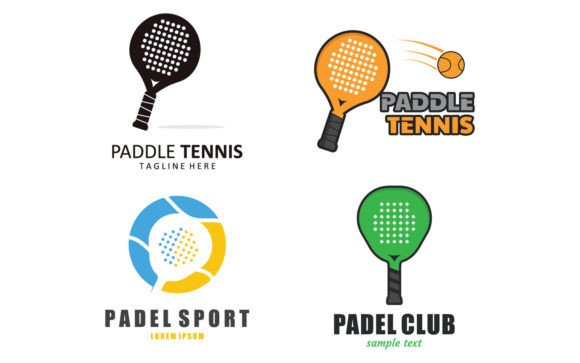
Evaluating the Vector Padel Tennis Logo Template for Brand Identity and Design Projects
Selecting the right visual identity for a padel club, tournament, or equipment shop requires balancing sport-specific recognition with broader design versatility. A Vector Padel Tennis Logo Template serves as a foundational resource for designers and business owners who need professional-grade graphics without the timeline or expense of custom illustration from scratch. Unlike raster-based images or generic sports icons, these templates provide editable paths that maintain crisp edges at any scale, from social media avatars to large-format court signage. Understanding the specific utility of these assets helps stakeholders determine whether a template is the appropriate solution or if alternative design approaches are necessary.
Distinguishing Vector Templates from Raster and Custom Alternatives
The primary distinction of a Vector Padel Tennis Logo Template lies in its technical format and adaptability. When comparing options for padel sport branding, decision-makers typically encounter three categories: raster stock images, vector templates, and bespoke commission work. Raster files (JPG, PNG) are pixel-dependent; enlarging them for a championship banner or shop facade results in pixelation and loss of clarity. In contrast, vector formats (AI, EPS, SVG) utilize mathematical equations to define lines and curves. This ensures that a silhouette of a player or a detailed racket illustration remains sharp regardless of dimension.
While custom design offers unique intellectual property, it often requires weeks of iteration and significant budget. A high-quality template bridges this gap by providing a professional graphic structure that can be modified to suit specific needs. For a local club organizing a weekend event or a startup launching a new line of paddle tennis gear, the template offers immediate deployment. However, users must recognize that templates are starting points, not final products. The value proposition depends entirely on the user's ability to customize the symbol, color palette, and typography to avoid looking generic.
Assessing Style Variations: Modern, Retro, and Minimalist Approaches
Padel culture encompasses diverse aesthetics, and templates generally fall into distinct stylistic categories. Evaluating which style aligns with your organizational goals is critical for effective communication.
- Modern and Dynamic: These designs often feature angular shapes, swoosh elements, and bold gradients to convey speed, action, and competition. They are best suited for elite athlete representation, high-performance training centers, or tech-forward equipment brands. The tradeoff is that they can sometimes feel impersonal or overly aggressive for community-focused recreation.
- Retro and Vintage: Utilizing textured overlays, classic badge layouts, and muted colors, these templates evoke the heritage of tennis and traditional racquet sports. They work exceptionally well for lifestyle brands, social clubs, or tournament merchandise aiming for a nostalgic feel. The limitation here is legibility; intricate vintage details may disappear when scaled down for mobile app icons or small label printing.
- Simple and Iconographic: Focusing on clean lines and negative space, these creative designs prioritize instant recognition. A minimalist ball and court outline communicates the activity without visual clutter. This approach is ideal for signage, wayfinding, and digital platforms where clarity is paramount. However, simple designs require stronger typographic choices to carry the brand personality, as the icon itself carries less emotional weight.
Practical Applications Across Different Padel Entities
The suitability of a Vector Padel Tennis Logo Template varies significantly depending on the end use case. What works for a product package may fail for a team jersey. Stakeholders should evaluate templates based on their specific operational context rather than aesthetic preference alone.
Clubs, Academies, and Training Centers
For facilities focused on recreation and activity, the logo must function across multiple touchpoints: staff uniforms, booking apps, facility signage, and promotional flyers. A template featuring a versatile emblem that combines text and imagery is often superior to a standalone symbol. The ability to separate the paddle graphic from the wordmark allows for flexible application—using just the icon for Instagram profile pictures while utilizing the full lockup for the reception desk sign. Decision-makers should verify that the template includes variations for light and dark backgrounds, as club environments often involve contrasting surfaces like glass courts and artificial turf.
Tournaments, Leagues, and Competitive Events
Competition branding has different requirements than facility branding. A championship logo needs to accommodate annual updates, such as changing years, host cities, or sponsor placements. Templates designed specifically for events often include modular layers for these variable elements. When evaluating options, look for designs that leave adequate negative space for sponsor integration without compromising the core match identity. A common pitfall is selecting a dense, complex illustration that becomes illegible when embroidered onto a cup winner’s polo or printed on a small wristband. Prioritize bold, scalable geometry over intricate shading for competitive contexts.
Equipment Retail and Product Branding
Retailers and manufacturers need visuals that translate to physical products. A Vector Padel Tennis Logo Template intended for merchandise must be tested against production constraints. Intricate gradients may look stunning on screen but can be costly or impossible to reproduce via screen printing or embroidery. For shop branding and product labels, simpler vector constructions with limited color counts are more practical. Additionally, retail branding often requires a distinct visual hierarchy to differentiate between house brands and third-party inventory. Ensure the chosen template possesses enough unique character to stand out on a shelf alongside established global brands.
Technical Considerations and Customization Requirements
Acquiring a template is only the first step; successful implementation requires technical due diligence. Not all vector files are created equal, and poor construction can lead to frustration during the editing process.
File Integrity and Editability
Before purchasing or downloading, verify the file specifications. True vector templates should have fully expandable strokes, outlined text (or included font files), and organized layer structures. Some low-quality resources claim to be vectors but contain embedded raster images or expanded effects that cannot be easily recolored. For a designer modifying a team logo, the ability to adjust anchor points and reshape the racquet handle or ball trajectory is essential. If the path data is messy or auto-traced, the time saved by using a template may be negated by the hours spent cleaning up artifacts.
Licensing and Intellectual Property
Understanding licensing terms is non-negotiable for commercial entities. Most template licenses permit use in end products but prohibit reselling the template itself or using it as a trademark without significant modification. Because templates are non-exclusive, other organizations may use the same base illustration. To mitigate this risk and secure distinctiveness, substantial alteration is recommended. Changing colors, rearranging elements, combining multiple assets, or integrating custom typography transforms a generic award graphic into proprietary brand equity. For organizations planning to trademark their identity, consulting a legal professional regarding the registrability of modified template art is advisable.
Making the Final Selection Decision
Choosing the right Vector Padel Tennis Logo Template ultimately comes down to aligning resources with objectives. If the goal is rapid deployment for a seasonal event, internal presentation, or MVP testing for a new padel venture, a template is an efficient, cost-effective solution. It provides immediate access to professional sports aesthetics and industry-standard symbolism that resonates with players and fans.
However, if the organization is a national federation, a premium luxury club, or a manufacturer seeking long-term trademark protection, a template should be viewed strictly as a mood board or conceptual reference rather than a final asset. In these high-stakes scenarios, the limitations of shared assets and pre-defined compositions may hinder brand differentiation. By honestly assessing the scope of the project, the required level of uniqueness, and the technical capacity for customization, stakeholders can leverage vector templates effectively while avoiding the pitfalls of generic design. The most successful implementations treat the template not as a finished answer, but as a strategic foundation upon which a distinctive classic or modern padel identity is built.